Oct 13, 2026
Stainless Steel Thickness for Veterinary Equipment: Why 0.8 mm, 1.0 mm, and 1.2 mm Matter
Stainless Steel Thickness for Veterinary Equipment: Why 0.8 mm, 1.0 mm, and 1.2 mm Matter
When purchasing stainless steel veterinary equipment, buyers often compare materials, dimensions, features, and prices. However, one important specification is frequently overlooked: the actual thickness of the stainless steel sheet.
Two veterinary cages may look almost identical in product photos, but differences in sheet thickness, structural reinforcement, and manufacturing quality can significantly affect their rigidity, weight, durability, and overall cost.
For veterinary hospitals, distributors, and project contractors, understanding stainless steel thickness helps ensure that equipment meets practical requirements without unnecessary spending.
At SINOWISE, our standard veterinary stainless steel equipment typically uses 1.0 mm actual sheet thickness for the applicable sheet-metal components. We believe buyers should understand what this specification means and how to evaluate it.
1. What Does Stainless Steel Thickness Mean?
Stainless steel thickness refers to the thickness of the metal sheet used to manufacture equipment components such as cage panels, doors, shelves, drawers, and work surfaces.
Common sheet thicknesses used in stainless steel equipment manufacturing include:
- 0.8 mm: A relatively lightweight option for suitable panels and components.
- 1.0 mm: A practical balance between material weight, rigidity, and manufacturing cost.
- 1.2 mm: A thicker option that can provide additional stiffness for certain applications.
- 1.5 mm or thicker: May be selected for components requiring higher structural rigidity or more demanding service conditions.
These are general examples, not universal industry standards. Different parts of the same product may require different thicknesses.
For example, the outer panel of a veterinary cage may not need the same thickness as a load-bearing support frame.
2. How Does Stainless Steel Thickness Affect Veterinary Equipment?
A. Structural Rigidity
One of the most important effects of sheet thickness is rigidity.
When material grade, panel dimensions, and support conditions remain the same, a thicker stainless steel sheet generally resists bending more effectively than a thinner one.
This can be particularly important for:
- Veterinary cage panels and doors
- Examination table surfaces
- Stainless steel trolley shelves
- Storage cabinet panels
- Worktops used in treatment areas
However, thickness alone does not determine overall product strength.
A well-designed product with properly positioned reinforcements can perform better than a thicker product with poor structural design.
Buying tip: Ask your supplier about both sheet thickness and structural reinforcement.
B. Resistance to Dents and Deformation
Veterinary equipment is frequently exposed to daily handling, cleaning, moving, and occasional impacts.
Thin panels may be more susceptible to visible dents or deformation under comparable conditions.
For example, a stainless steel trolley may experience repeated contact with other equipment while moving through a busy veterinary hospital.
Using suitable material thickness, reinforced shelves, and a stable frame helps improve its performance in everyday use.
C. Equipment Weight
Increasing stainless steel thickness also increases material weight.
For identical sheet dimensions, 1.2 mm stainless steel contains approximately 20% more material by volume than 1.0 mm stainless steel.
Similarly, 1.0 mm sheet contains approximately 25% more material by volume than 0.8 mm sheet.
This affects:
- Material costs
- Equipment weight
- Handling requirements
- Transportation costs
- Overall product design
For mobile veterinary equipment, such as instrument trolleys, choosing an appropriate thickness is especially important.
The goal is to achieve sufficient strength without making the equipment unnecessarily heavy.
D. Manufacturing Cost
Stainless steel is a major cost component of veterinary hospital equipment.
A thicker sheet generally requires more raw material and may affect forming, welding, and fabrication requirements.
For buyers comparing quotations, a lower price does not always mean a better deal.
Two products with the same external dimensions may have different material specifications and manufacturing structures.
Before comparing prices, confirm whether suppliers are quoting products with equivalent materials and construction.
E. Long-Term Durability
Appropriate material thickness can help reduce deformation and improve resistance to certain mechanical stresses.
However, durability also depends on:
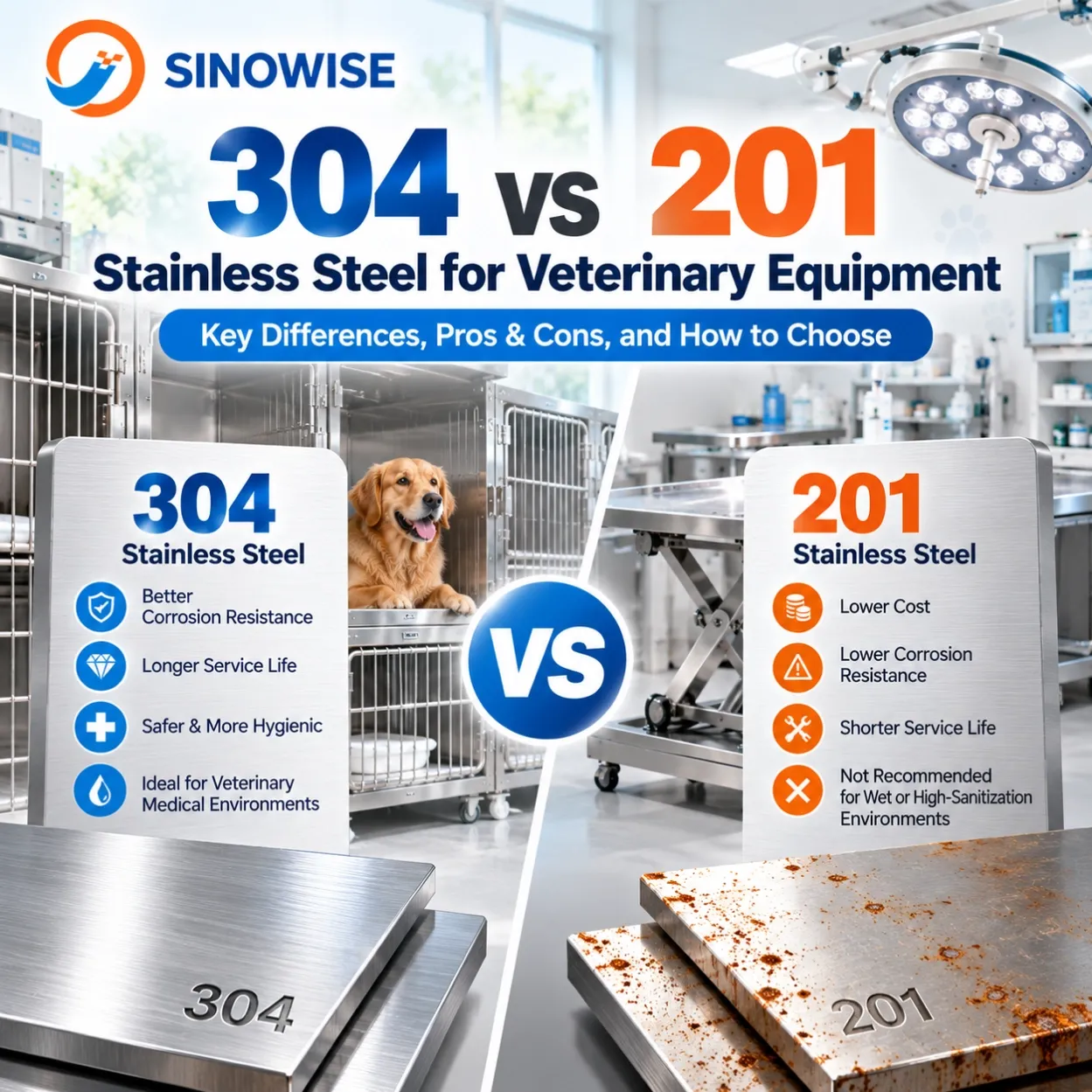
- Stainless steel grade, such as 304 or 201
- Welding quality
- Surface finishing
- Structural design
- Cleaning and maintenance
- Operating environment
For example, 304 stainless steel is often preferred for veterinary equipment exposed to frequent cleaning and moisture because of its corrosion resistance.
Thickness and stainless steel grade should therefore be evaluated together.
3. Comparing 0.8 mm, 1.0 mm, and 1.2 mm Stainless Steel
Feature | 0.8 mm | 1.0 mm | 1.2 mm |
|---|---|---|---|
Material weight | Lower | Medium | Higher |
Raw material usage | Lower | Medium | Higher |
Panel rigidity under comparable conditions | Lower | Higher | Highest |
Resistance to deformation under comparable conditions | Lower | Higher | Highest |
Typical consideration | Lightweight panels | Balanced everyday applications | Components needing greater stiffness |
Cost consideration | Usually lower | Moderate | Usually higher |
Important: This comparison assumes the same stainless steel grade, panel dimensions, and structural design. Actual product performance must be evaluated according to its construction and intended load.
4. Why Does SINOWISE Use 1.0 mm Actual Stainless Steel Thickness for Standard Products?
At SINOWISE, our standard veterinary stainless steel equipment typically uses 1.0 mm actual sheet thickness for the relevant sheet-metal components.
We consider this a practical choice for many everyday veterinary applications because it offers a balance of:
Structural performance
Suitable sheet thickness, combined with appropriate reinforcement and fabrication, helps maintain product rigidity during normal use.
Material efficiency
Using an appropriate thickness avoids unnecessary material consumption while meeting the intended design requirements.
Cost-effectiveness
A balanced material specification helps us provide competitive equipment solutions without relying solely on reducing material thickness.
Manufacturing flexibility
Different veterinary hospitals may require different sizes, configurations, and equipment designs. Material specifications can be evaluated according to the application.
For projects involving special dimensions, heavier loads, or other demanding conditions, our team can discuss suitable structural and material options.
5. Does Thicker Stainless Steel Always Mean Better Veterinary Equipment?
Not necessarily.
Consider two veterinary examination tables:
Table A uses thicker stainless steel sheets but has limited structural reinforcement.
Table B uses appropriately sized sheets combined with a reinforced frame and carefully designed support structure.
Depending on their actual construction and loading conditions, Table B may perform as well as or better than Table A.
Therefore, buyers should not judge quality based on sheet thickness alone.
A professional supplier should also explain:
- Which components use the specified thickness?
- What stainless steel grade is used?
- How are the load-bearing structures reinforced?
- What is the recommended working load?
- How are welding and finishing quality controlled?
These questions help buyers compare equipment more accurately.
6. How to Verify Actual Stainless Steel Thickness
When sourcing veterinary equipment from overseas manufacturers, buyers should distinguish between nominal sheet thickness and actual measured thickness.
Depending on the applicable material standard and purchasing specification, manufacturing tolerances may affect measured values.
For better purchasing transparency, buyers can request:
- Material specifications
- Confirmation of the actual sheet thickness
- Thickness measurement photos or videos
- Details of which components use each thickness
- Material certificates when applicable
- Pre-shipment inspection records
Thickness can be checked using suitable measuring instruments, such as a micrometer or caliper, on accessible sheet edges or samples.
Measurements should account for surface finishes and should be taken at appropriate locations.
At SINOWISE, we encourage customers to confirm material specifications before production to ensure that the equipment matches their purchasing requirements.
7. Choosing the Right Thickness for Different Veterinary Products
Stainless Steel Veterinary Cages
For veterinary cages, sheet thickness should be considered together with:
- Cage dimensions
- Door construction
- Number of tiers
- Reinforcement
- Animal weight
- Floor and tray design
Larger cages or special configurations may require additional reinforcement or different material specifications.
Veterinary Operating Tables
Operating tables require particular attention to load-bearing performance and stability.
The tabletop thickness is only one part of the design. The supporting frame, lifting mechanism, joints, and base structure are also critical.
Buyers should prioritize verified working-load specifications rather than assuming that a thicker tabletop automatically means a stronger operating table.
Veterinary Instrument Trolleys
For instrument trolleys, the correct balance between weight and strength is important.
The design should consider shelf loads, frame construction, caster capacity, and movement over hospital floors.
Veterinary Examination Tables
Examination tables must provide a stable working surface suitable for routine clinical procedures.
Material thickness, frame reinforcement, and support spacing all contribute to performance.
8. Questions to Ask Before Ordering Stainless Steel Veterinary Equipment
Before placing an order, consider asking your manufacturer:
- Is the quoted thickness nominal or actual?
- Which parts of the product use 1.0 mm stainless steel?
- Is the material 304 stainless steel or another grade?
- Can the manufacturer provide thickness measurements?
- What reinforcement is used in load-bearing areas?
- Can the thickness be customized for special applications?
- Will changing thickness affect the price and delivery time?
Clear specifications help reduce misunderstandings and make quotations easier to compare.
Conclusion: Choose the Right Thickness, Not Simply the Thickest Material
Stainless steel thickness is an important factor in veterinary equipment quality, but it should never be evaluated in isolation.
For most buyers, the best solution is equipment that combines suitable sheet thickness, reliable structural design, appropriate stainless steel grade, and consistent manufacturing quality.
At SINOWISE, our standard equipment typically uses 1.0 mm actual stainless steel sheet thickness for the applicable components. We also understand that different veterinary facilities have different requirements.
Whether you are purchasing stainless steel veterinary cages, operating tables, examination tables, or instrument trolleys, our team can help you review product specifications and discuss suitable customization options.
Looking for reliable stainless steel veterinary equipment?
ContacStainless Steel Thickness for Veterinary Equipment: Why 0.8 mm, 1.0 mm, and 1.2 mm Matter
When purchasing stainless steel veterinary equipment, buyers often compare materials, dimensions, features, and prices. However, one important specification is frequently overlooked: the actual thickness of the stainless steel sheet.
Two veterinary cages may look almost identical in product photos, but differences in sheet thickness, structural reinforcement, and manufacturing quality can significantly affect their rigidity, weight, durability, and overall cost.
For veterinary hospitals, distributors, and project contractors, understanding stainless steel thickness helps ensure that equipment meets practical requirements without unnecessary spending.
At SINOWISE, our standard veterinary stainless steel equipment typically uses 1.0 mm actual sheet thickness for the applicable sheet-metal components. We believe buyers should understand what this specification means and how to evaluate it.
1. What Does Stainless Steel Thickness Mean?
Stainless steel thickness refers to the thickness of the metal sheet used to manufacture equipment components such as cage panels, doors, shelves, drawers, and work surfaces.
Common sheet thicknesses used in stainless steel equipment manufacturing include:
- 0.8 mm: A relatively lightweight option for suitable panels and components.
- 1.0 mm: A practical balance between material weight, rigidity, and manufacturing cost.
- 1.2 mm: A thicker option that can provide additional stiffness for certain applications.
- 1.5 mm or thicker: May be selected for components requiring higher structural rigidity or more demanding service conditions.
These are general examples, not universal industry standards. Different parts of the same product may require different thicknesses.
For example, the outer panel of a veterinary cage may not need the same thickness as a load-bearing support frame.
2. How Does Stainless Steel Thickness Affect Veterinary Equipment?
A. Structural Rigidity
One of the most important effects of sheet thickness is rigidity.
When material grade, panel dimensions, and support conditions remain the same, a thicker stainless steel sheet generally resists bending more effectively than a thinner one.
This can be particularly important for:
- Veterinary cage panels and doors
- Examination table surfaces
- Stainless steel trolley shelves
- Storage cabinet panels
- Worktops used in treatment areas
However, thickness alone does not determine overall product strength.
A well-designed product with properly positioned reinforcements can perform better than a thicker product with poor structural design.
Buying tip: Ask your supplier about both sheet thickness and structural reinforcement.
B. Resistance to Dents and Deformation
Veterinary equipment is frequently exposed to daily handling, cleaning, moving, and occasional impacts.
Thin panels may be more susceptible to visible dents or deformation under comparable conditions.
For example, a stainless steel trolley may experience repeated contact with other equipment while moving through a busy veterinary hospital.
Using suitable material thickness, reinforced shelves, and a stable frame helps improve its performance in everyday use.
C. Equipment Weight
Increasing stainless steel thickness also increases material weight.
For identical sheet dimensions, 1.2 mm stainless steel contains approximately 20% more material by volume than 1.0 mm stainless steel.
Similarly, 1.0 mm sheet contains approximately 25% more material by volume than 0.8 mm sheet.
This affects:
- Material costs
- Equipment weight
- Handling requirements
- Transportation costs
- Overall product design
For mobile veterinary equipment, such as instrument trolleys, choosing an appropriate thickness is especially important.
The goal is to achieve sufficient strength without making the equipment unnecessarily heavy.
D. Manufacturing Cost
Stainless steel is a major cost component of veterinary hospital equipment.
A thicker sheet generally requires more raw material and may affect forming, welding, and fabrication requirements.
For buyers comparing quotations, a lower price does not always mean a better deal.
Two products with the same external dimensions may have different material specifications and manufacturing structures.
Before comparing prices, confirm whether suppliers are quoting products with equivalent materials and construction.
E. Long-Term Durability
Appropriate material thickness can help reduce deformation and improve resistance to certain mechanical stresses.
However, durability also depends on:
- Stainless steel grade, such as 304 or 201
- Welding quality
- Surface finishing
- Structural design
- Cleaning and maintenance
- Operating environment
For example, 304 stainless steel is often preferred for veterinary equipment exposed to frequent cleaning and moisture because of its corrosion resistance.
Thickness and stainless steel grade should therefore be evaluated together.
3. Comparing 0.8 mm, 1.0 mm, and 1.2 mm Stainless Steel
Feature | 0.8 mm | 1.0 mm | 1.2 mm |
|---|---|---|---|
Material weight | Lower | Medium | Higher |
Raw material usage | Lower | Medium | Higher |
Panel rigidity under comparable conditions | Lower | Higher | Highest |
Resistance to deformation under comparable conditions | Lower | Higher | Highest |
Typical consideration | Lightweight panels | Balanced everyday applications | Components needing greater stiffness |
Cost consideration | Usually lower | Moderate | Usually higher |
Important: This comparison assumes the same stainless steel grade, panel dimensions, and structural design. Actual product performance must be evaluated according to its construction and intended load.
4. Why Does SINOWISE Use 1.0 mm Actual Stainless Steel Thickness for Standard Products?
At SINOWISE, our standard veterinary stainless steel equipment typically uses 1.0 mm actual sheet thickness for the relevant sheet-metal components.
We consider this a practical choice for many everyday veterinary applications because it offers a balance of:
Structural performance
Suitable sheet thickness, combined with appropriate reinforcement and fabrication, helps maintain product rigidity during normal use.
Material efficiency
Using an appropriate thickness avoids unnecessary material consumption while meeting the intended design requirements.
Cost-effectiveness
A balanced material specification helps us provide competitive equipment solutions without relying solely on reducing material thickness.
Manufacturing flexibility
Different veterinary hospitals may require different sizes, configurations, and equipment designs. Material specifications can be evaluated according to the application.
For projects involving special dimensions, heavier loads, or other demanding conditions, our team can discuss suitable structural and material options.
5. Does Thicker Stainless Steel Always Mean Better Veterinary Equipment?
Not necessarily.
Consider two veterinary examination tables:
Table A uses thicker stainless steel sheets but has limited structural reinforcement.
Table B uses appropriately sized sheets combined with a reinforced frame and carefully designed support structure.
Depending on their actual construction and loading conditions, Table B may perform as well as or better than Table A.
Therefore, buyers should not judge quality based on sheet thickness alone.
A professional supplier should also explain:
- Which components use the specified thickness?
- What stainless steel grade is used?
- How are the load-bearing structures reinforced?
- What is the recommended working load?
- How are welding and finishing quality controlled?
These questions help buyers compare equipment more accurately.
6. How to Verify Actual Stainless Steel Thickness
When sourcing veterinary equipment from overseas manufacturers, buyers should distinguish between nominal sheet thickness and actual measured thickness.
Depending on the applicable material standard and purchasing specification, manufacturing tolerances may affect measured values.
For better purchasing transparency, buyers can request:
- Material specifications
- Confirmation of the actual sheet thickness
- Thickness measurement photos or videos
- Details of which components use each thickness
- Material certificates when applicable
- Pre-shipment inspection records
Thickness can be checked using suitable measuring instruments, such as a micrometer or caliper, on accessible sheet edges or samples.
Measurements should account for surface finishes and should be taken at appropriate locations.
At SINOWISE, we encourage customers to confirm material specifications before production to ensure that the equipment matches their purchasing requirements.
7. Choosing the Right Thickness for Different Veterinary Products
Stainless Steel Veterinary Cages
For veterinary cages, sheet thickness should be considered together with:
- Cage dimensions
- Door construction
- Number of tiers
- Reinforcement
- Animal weight
- Floor and tray design
Larger cages or special configurations may require additional reinforcement or different material specifications.
Veterinary Operating Tables
Operating tables require particular attention to load-bearing performance and stability.
The tabletop thickness is only one part of the design. The supporting frame, lifting mechanism, joints, and base structure are also critical.
Buyers should prioritize verified working-load specifications rather than assuming that a thicker tabletop automatically means a stronger operating table.
Veterinary Instrument Trolleys
For instrument trolleys, the correct balance between weight and strength is important.
The design should consider shelf loads, frame construction, caster capacity, and movement over hospital floors.
Veterinary Examination Tables
Examination tables must provide a stable working surface suitable for routine clinical procedures.
Material thickness, frame reinforcement, and support spacing all contribute to performance.
8. Questions to Ask Before Ordering Stainless Steel Veterinary Equipment
Before placing an order, consider asking your manufacturer:
- Is the quoted thickness nominal or actual?
- Which parts of the product use 1.0 mm stainless steel?
- Is the material 304 stainless steel or another grade?
- Can the manufacturer provide thickness measurements?
- What reinforcement is used in load-bearing areas?
- Can the thickness be customized for special applications?
- Will changing thickness affect the price and delivery time?
Clear specifications help reduce misunderstandings and make quotations easier to compare.
Conclusion: Choose the Right Thickness, Not Simply the Thickest Material
Stainless steel thickness is an important factor in veterinary equipment quality, but it should never be evaluated in isolation.
For most buyers, the best solution is equipment that combines suitable sheet thickness, reliable structural design, appropriate stainless steel grade, and consistent manufacturing quality.
At SINOWISE, our standard equipment typically uses 1.0 mm actual stainless steel sheet thickness for the applicable components. We also understand that different veterinary facilities have different requirements.
Whether you are purchasing stainless steel veterinary cages, operating tables, examination tables, or instrument trolleys, our team can help you review product specifications and discuss suitable customization options.
Looking for reliable stainless steel veterinary equipment?
Contact SINOWISE to request product specifications, discuss custom dimensions, or receive a quotation for your veterinary hospital project.
Call to Action: Request Product Specifications & a Quotet SINOWISE to request product specifications, discuss custom dimensions, or receive a quotation for your veterinary hospital project.
Call to Action: Request Product Specifications & a Quote