Sep 16, 2026
How to Choose Stainless Steel Veterinary Cages for Your Clinic
How to Choose Stainless Steel Veterinary Cages for Your Clinic
Choosing stainless steel veterinary cages is about more than finding a unit that fits against a wall. You need to consider the patients your clinic treats, the usable space inside each compartment, cleaning access and the equipment your team needs during hospitalization.
A practical purchasing decision starts with a simple question: Will this cage configuration work for our patients, our staff and our daily routines?
This guide explains what to check before ordering, with examples from the Sinowise PLVC-A04 and PLVC-004 series.
1. Start with Your Clinic’s Patient and Care Requirements
Before comparing models, prepare a short description of how the cages will be used. Consider your expected patient numbers, the range of animal sizes you regularly treat and whether stays are usually short or extended.
Avoid choosing a cage bank only by the number of doors. Instead, ask for the usable internal dimensions of every compartment and compare them with the space needed for each patient and its furnishings.
For feline patients, the ISFM/AAFP veterinary environment guidelines emphasize providing space for resting, hiding and essential resources, with food, water and litter areas separated as much as possible. This makes the internal layout—not just the overall size of the cabinet—an important selection factor.
Prepare a basic patient profile before requesting a quotation: typical animal sizes, expected occupancy and the type of care provided. This gives your supplier a clearer basis for recommending a configuration.
2. Compare Overall Dimensions and Internal Cage Space Separately
The first dimensional check is whether the complete unit fits your room. The second is whether each compartment provides suitable usable space. These are different questions.
The following Sinowise models illustrate why overall dimensions should be compared carefully:
Model | Published Unit Dimensions, L × W × H | Features Identified in the Product Literature |
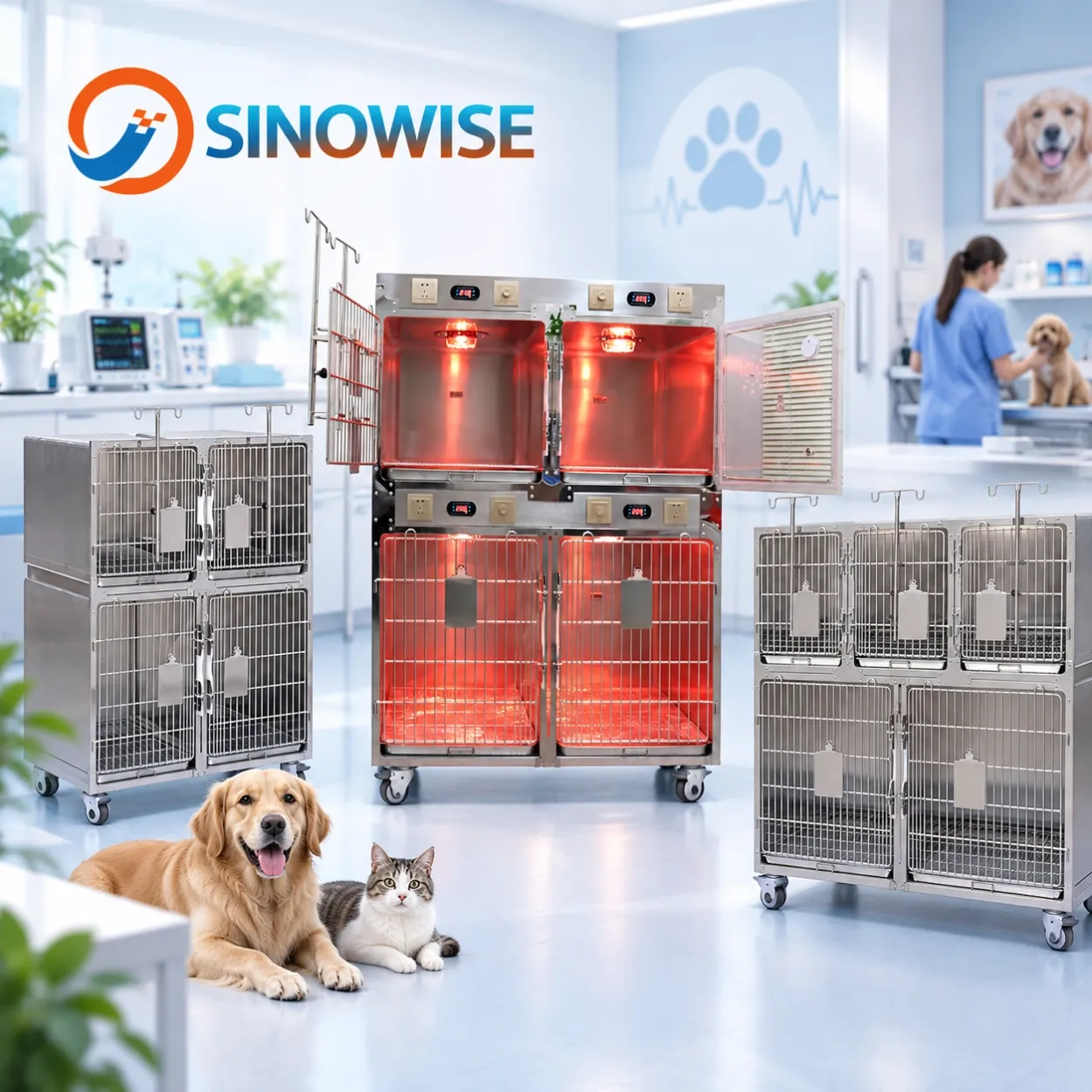
PLVC-A04 Pet Hospital Cage | 1220 × 700 × 1570 mm | 304 stainless steel construction, rounded internal corners and a two-tier, four-door arrangement shown in the catalogue. |
PLVC-004 / NEW | 1220 × 700 × 1830 mm | Oxygen-chamber configuration, infrared lamps and thermostatic control listed in the series literature. Confirm the exact configuration for the selected version. |
These models have the same published length and width, but the PLVC-004 series is 260 mm taller. That difference matters when planning placement beneath shelves, near wall-mounted equipment or along an installation route.
However, the dimensions above describe the complete units. They should not be treated as the internal dimensions of individual compartments.
Request a dimensioned drawing showing clear internal width, depth and height, door openings and any partitions. Do not estimate compartment dimensions by dividing the cabinet’s external width by the number of doors.
Also check doorway clearances, corridor turns, elevator dimensions and the space needed to open doors and remove trays. Ask whether the stated height includes casters, control panels and any projecting accessories.
3. Check the Stainless Steel Grade and Construction Details
“Stainless steel” should be the beginning of a specification, not the entire specification.
For example, the Sinowise PLVC-A04 product literature specifies 304 stainless steel and rounded internal corners designed to simplify cleaning. These are useful details to compare when reviewing quotations.
For any model under consideration, ask the supplier to identify the material used for the cage body, doors, floor grids, trays and hardware. Request information about sheet thickness and close-up photographs of welds, edges and corners.
Do not assume that a material specification confirmed for one model automatically applies to every product in the range.
It is also important to distinguish corrosion resistance from complete immunity to corrosion. Stainless steel performance depends on its grade, surface condition and operating environment; chloride-containing environments can contribute to localized corrosion. Follow the equipment manufacturer’s cleaning and chemical-compatibility instructions rather than assuming every disinfectant is suitable.
A useful quotation should describe the construction clearly enough for you to compare more than appearance and price.
4. Evaluate Cleaning Access Before Placing an Order
A product photograph rarely shows the entire cleaning process. Ask for a demonstration that includes opening the doors, accessing corners, removing the components intended for removal and putting everything back together.
The PLVC-A04 literature highlights rounded internal corners. The PLVC-004 series literature also identifies a removable tray and rounded-corner construction. These provide specific features to examine during a product demonstration.
During your review, consider practical questions:
Can your team reach the back of every compartment? Is there enough clearance to remove a tray fully? Which floor panels or partitions are removable? Can replacement trays and other frequently handled parts be supplied?
Ask for cleaning instructions covering the complete product, including any transparent doors, seals, displays and electrical components—not only the stainless steel surfaces.
Evaluate the cage as something your team will clean and maintain repeatedly, not simply as a new item in a showroom.
5. Consider Patient Comfort, Visibility and Staff Access
Material and dimensions are important, but the surrounding environment and cage furnishings also deserve attention.
For cats, the ISFM/AAFP guidelines favor non-reflective finishes, such as brushed stainless steel, and construction that does not readily flex or generate noise. They also emphasize appropriate bedding, hiding opportunities and a layout suited to the individual patient.
When assessing a model, listen to the door and latch during operation. Look at the interior finish and consider how the enclosure will be furnished. Check whether staff can observe the patient clearly without repeatedly opening the door.
Cage height should also be considered from the staff’s perspective. Veterinary environment guidelines note that cages positioned too high or too low can make patient interaction difficult. Review access to both tiers with the people who will actually use them.
Do not approve a configuration solely because its overall dimensions fit the room. Review the complete setup: enclosure, furnishings, visibility and access.
6. Inspect Doors, Latches, Casters and Stability
Before ordering a veterinary cage bank, request a short video showing the doors and latches in use. Ask how the locking mechanism works, how closure is confirmed and whether replacement hardware is available.
For mobile models, check the caster specifications and how the unit is secured in its working position. The PLVC-A04 catalogue shows the cage mounted on casters, but wheel type, braking arrangements and load ratings should be confirmed in the final specification.
Other useful questions include whether the unit arrives fully assembled, which parts require installation and whether any anchoring or additional stabilization is required.
Treat these as purchasing checks rather than assumptions based on a photograph. Clear answers help you prepare the installation space and compare suppliers on an equivalent basis.
7. Distinguish Standard Housing from Additional Care Features
Not every cage needs the same equipment package. Compare basic housing requirements separately from additional oxygen-related or temperature-control features.
The PLVC-004 series literature lists an oxygen-chamber configuration, infrared lamps, thermostatic control, temperature and humidity display, and a touchscreen feature within the series presentation. Confirm which features belong to the exact version being quoted.
Feature names alone are not a complete technical specification. For example, a humidity display does not establish that automatic humidity control is included. Similarly, an oxygen-chamber description does not establish that an oxygen concentrator is supplied.
Before selecting these options, request written details of the gas-supply requirements, included sensors, control functions, alarms, electrical requirements and maintenance procedures. Have your veterinary team review the operating documentation and suitability for the intended use.
Choose additional functions because they match a defined clinical requirement—not simply because a model has more controls or a more advanced appearance.
8. Compare the Complete Quotation, Not Only the Cage Price
Create a like-for-like comparison before deciding which quotation offers the best fit.
Ask each supplier to confirm the exact model, material specification, compartment dimensions, included accessories, packaging dimensions, gross weight and assembly requirements. Clarify warranty coverage and the availability of replacement latches, casters, trays and electrical components where applicable.
For international orders, compare quotations using the same delivery destination and shipping basis. Keep the product dimensions separate from the packaged dimensions used for transport planning.
A lower initial price may not represent the better option when an essential accessory, installation requirement or delivery charge has been omitted. A clear specification makes these differences easier to identify before payment.
Find the Right Veterinary Cage Configuration with Sinowise
Start with your patients and your daily routines, then compare usable space, construction, cleaning access and the functions your team actually needs.
The PLVC-A04 and PLVC-004 series provide useful examples of different housing configurations. The right choice should be based on the final specification and intended use, rather than the model name alone.
Planning a new veterinary clinic or updating your hospitalization area?
Send Sinowise your available installation dimensions, typical patient sizes, required quantity and destination country. Request a model-specific quotation with confirmed dimensions, included accessories and delivery details.
Contact Sinowise to discuss your veterinary cage requirements.
Muriel
Whasapp:+8618001481287